
By Albora Aydin
MA in Transpersonal Psychology student
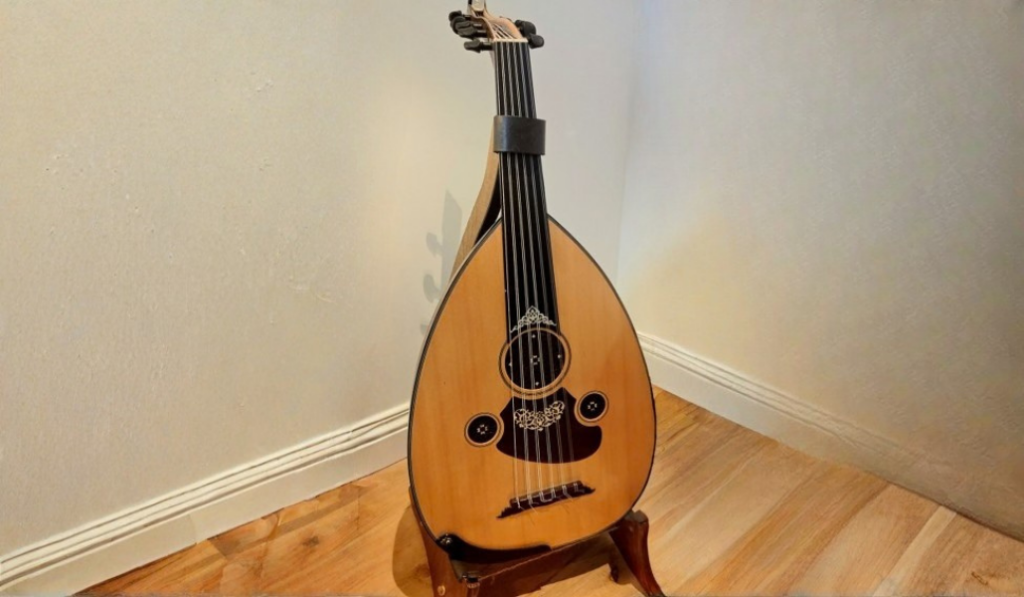
Last week I picked up my instrument again. It has been mine for most of my adult life.
Not to play it. I tuned it. I checked the strings, wiped the body, held it for a while. The way you hold something you are not sure still belongs to you.
Then I put it back. No music came out of it. That was fine. It was not the point.
I have not played in years.
• • •
Before that
There was a time when I would have found this pathetic.
I write music and I produce it. Or I did. Which is my excuse for the home studio. Not a corner of a room with a laptop. A studio. Acoustic treatment on the walls. Monitors that cost more than my first car. Microphones so sensitive they could probably record a mouse thinking about breathing in the next building. Preamps, processors and cables with opinions about themselves.
If you’d asked me why I needed all this, I would have given you a serious answer about production quality, headroom and signal chains and whatnot. The thing is I would have believed it. I didn’t need any of it. Most people like me don’t. I was producing music in a room alone. But that wasn’t really what the gear was for…
People used to say things like ‘Oh, you are so creative. I did not know you could do that. How do you even come up with this?’ And I would do the small modest face. Inside, something would settle, calm and warm, like a cat finding the one square of sun in the room.
I’d post a piece online and watch the likes arrive. Each one confirming the same sentence: yes, you are that. That was the product. Not the music. That short sentence.
• • •
What the music was actually doing
Here is the part that took me years to see:
I grew up not showing what I felt. In my family this was simply how things were done, and I was good at it. Anger, sadness, longing, the whole crowd of them. They never appeared on my face. But they did not disappear either.
They went into the music.
I would sit down with instruments and imagine I was saying something to a specific person or to a specific emotional state. Something I would never say out loud. It came out beautiful, and it came out safe, because it came out as sound instead of speech. Nobody could ask me what I meant.
I could feel everything at full volume and still never be caught feeling it. Full volume, by the way, is not a figure of speech. I lost some of my hearing to those years.
I used to call this expression. It was the opposite.
It was a hiding place with good acoustics.
• • •
Then it stopped
I do not have a dramatic story about how the music ended. There was no fight, no breakdown, no moment. It just thinned out. Longer gaps between sessions. Then longer. Then the equipment stayed off.
For a while I told myself I was busy. Then I told myself I was in a phase. Then I stopped telling myself anything.
The studio sat there gathering dust, and the dust started to feel like an accusation. Every time I walked past it, the room asked me a question I did not want to answer. What I did not understand at the time is that the emotions did not stop when the music stopped. They only lost their exit.
So they went down instead.
I fell into a depression. A serious one, the first of my life, and it lasted a long time. I had always been the person other people came to when things got heavy. I was not prepared to be the heavy thing. I was the joyful one.
Those were the years I now think of as my creative winter. At the time nobody would have called it creative, and it did not feel like a season. Seasons end. That is the whole idea of a season. This did not appear to be going anywhere.
• • •
What actually helped
I want to be careful here, because this is the part where stories like this usually take a shortcut.
Nothing was fixed by a realization.
I did not wake up one morning with an insight and feel better. What happened was slower and much less charming than that.
It started with shadow work. Sitting with the parts of myself I had spent decades keeping in a back room, and looking at them properly instead of glancing and leaving. It was unpleasant and truly painful. Somewhere in there I came face to face with my core wound. The old one. The one everything else had been arranged around.
It was also the first thing in a long time that felt like it was actually touching the problem.
Once I saw what was going on inside me, I did the thing I should have done much earlier. I looked for help. I found a therapist who works in depth psychology.
In the first meeting I told her something I did not plan to say. I said: ‘I am grieving for the person that I was. I have immense pain because I feel like I am saying goodbye to my identity, it feels like I’m dying and I need your help in this process of grief’.
I remember being surprised at myself for knowing that. But I did know it. Somewhere underneath all the confusion, I understood that this was not an illness that had arrived from outside.
It was a funeral I had not agreed to attend.
The grief was worse than I expected, because of one thing nobody warns you about. When the old identities left, nothing came to replace them. There was no new me waiting in the next room. There was just the empty room.
Total emptiness. And where there’s nothing, there’s no joy either. Not sadness exactly. Just nothing, for a very long time.
That was the beginning. Not the end. Therapy is not a montage. It is many ordinary hours over a long period, and it is work, and it is slow.
• • •
What had actually died:
Somewhere in the middle of all this, a thought arrived that reorganized everything.
I had always assumed my creativity had left me. That was the story. The gift dried up, the well went empty, whatever metaphor you prefer. It’s a good story. It also lets you off the hook completely, because a well going dry is nobody’s fault.
But when I looked at it honestly, something did not fit.
I did not miss making music. I missed being the one who makes music.
The drive was never about the instrument or the music itself. It was about being the creative one. That identity needed music the way a building needs a foundation, and I had spent years pouring concrete without ever once asking what the building was for.
So when the identity started coming apart, the music went with it. Not because I had lost the ability. Because the thing that had been using the ability had let go.
Let me say that more plainly, because it took me long enough to understand it; two things had been standing in the same spot for years. My ability to make music, and the identity of being a creative person. From outside they looked like one thing. From inside they felt like one thing.
When the identity collapsed, I looked at the empty spot and assumed my creativity had died. It had not. It was just standing there quietly, with nobody using it anymore.
• • •
Now
Something has changed in the last months. I am cautious about how I say it, because I do not want to hand anyone a false ending.
I feel lighter. Not fixed. Lighter. It arrives a little more each week. Some days I catch myself feeling something that took me a while to recognize, because it had been gone so long.
Joy. Small, unspectacular joy, the kind that does not announce itself.
And music has started to become just music again. Not proof. Not a résumé. Not a place to put feelings I refuse to say out loud. Just sound, made by someone, and I can listen to it without measuring myself against it.
Which brings me back to the instrument in my hands last week.
I tuned it. I checked it over. I did not play. And for the first time in years, that did not feel like failure. It felt like maintenance. You take care of something because it’s yours and worth cherishing; not because it owes you anything or must perform for you, but simply because you love it.
I do not know if I will play or write again. I think I probably will. But I am not going to promise it, not to you and not to myself. The promising is exactly the old machinery starting up again, and I would like to leave that machinery off for a while.
For now the instrument is in tune. That is enough.
If you are somewhere in your own quiet stretch, wondering where your thing went, I would offer only this. Ask what it was carrying for you. Sometimes the thing does not leave. It just puts down a weight it was never supposed to be holding, and stands there empty for a while, waiting for you to come back and pick it up for a better reason. Ask for help if you need. Don’t wait.
Facing yourself is one of the most courageous and terrifying things a person can do. I did not know that when I started. I know it now.
As for the studio, it’s going on eBay because I’ve finally met my true self and he is not interested in high end music production. Piece by piece, until all that is left is a laptop and an audio interface, which is all I ever needed. Somebody out there is about to own a microphone that can hear mice think! Let’s make some money out of this 😌