
By Simmone Misra
PhD in Transpersonal Psychology student
For decades, corporations have rewarded people who could absorb enormous quantities of information, analyze more data, respond immediately, stay connected, and make decisive calls under pressure. AI is changing the economics of those abilities. As basic cognitive skills become commoditized, value is moving rapidly up the stack: the question is no longer simply, “Can you retain, think, and decide?” but “What deserves analysis, and what distinguishes a technically correct answer from the right one?” Trustworthy judgment is becoming the whole job, and judgment cannot be compressed into a prompt or contained in a context window.
Yet the infrastructure needed to create this distinctly human value is not in place. Most corporate professionals remain trapped in “input mode,” making it difficult to cultivate exceptional judgment and relevance. I decided to test a different operating environment: what would happen if I deliberately stepped out of a high-performance, high-input culture for 48 hours? This article recounts my weekend yoga retreat with SoulFlow + Co at the Nectar Experience on Bowen Island, off the coast of Vancouver—one of North America’s top yoga-retreat destinations.
On Friday morning, I shut down my laptop and climbed into a carpool with two women I had never met. It was a delightful beginning to the process of getting to know them, and in the process, myself. I could not remember the last time I had met someone new and sustained a conversation for the four-hour journey from Seattle to Bowen Island. By the time the ferry docked, something in my nervous system had already begun to downshift. We arrived and checked into a charming cottage with an outdoor shower, nature bathing in its fullest form; then gathered for an exquisite, farm-to-table plant-based dinner served al fresco. Around the table were accomplished women from many walks of life.

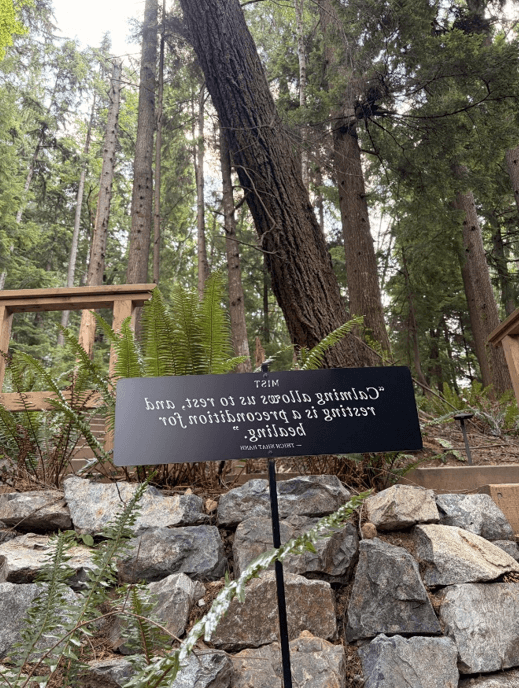
Saturday morning began with the Mist Thermal Experience, shifting my attention from brain to body. Corporate life keeps us cognitively driven: we sit through meetings, sift through heaps of emails, listen to podcasts, and work on screens. Here, the body became the primary experience of heat, cold, breath, and sensation. The contrast with AI felt immediate. AI operates in the realm of information; this pause returned me to the realm of lived experience.
The afternoon was deliberately left as “free time,” which I found surprisingly unsettling. I am accustomed to tightly structured days: a calendar packed with meetings, often double-booked, and a continuous stream of planned and unexpected activity. Corporate culture has long treated every idle minute as waste. But AI may finally make that philosophy obsolete. If machines can accelerate the input-analyze-churn cycle, perhaps our most human advantage lies in protecting unoptimized time, the space in which insight, imagination, and better questions can emerge.
The evening session before dinner was breathwork in a dome, and the experiment moved fully into physiology. We often speak of leadership as though it operates through a disembodied rational brain. It does not. Every day, corporate “warriors” make decisions while tired, anxious, afraid, excited, optimistic, pessimistic, or emotionally attached to being right. AI can help us reason, but it cannot determine which of our internal signals deserve our trust. In that sense, self-awareness is not a wellness accessory, it is a leadership tool.
The data points in the same direction. BCG’s 2026 CEO research suggests that many leaders are spending a disproportionate amount of time in short-term firefighting, while also reporting stress levels that sit well above a healthy baseline. That matters because stress is not just a feeling; it changes how we think. Amy Arnsten of Yale University School of Medicine argues that prolonged stress can narrow cognitive flexibility, impair aspects of memory, and could reduce creative originality, and interfere with deliberate decision-making. In other words, you can have strong judgment and still make a poor call when your nervous system is operating as though it is constantly braced for impact.
So, this is worth taking seriously as physiology, not simply as “vibes.” Heart-rate variability, one marker of how flexibly the autonomic nervous system moves between activation and recovery, is closely tied to self-regulation. Research on nature exposure points in a similar direction. Experimental studies have found that brief immersion in nature can enhance neural markers of executive control and performance monitoring, while exposure to natural environments has also been associated with less impulsive decision-making. Neuroimaging research further suggests that nature exposure can alter brain networks involved in attention, stress regulation, and cognitive control. None of these are a metaphor for judgment. It is the operating system judgment depends on, and it is what I mean when I say we need to rebuild the human infrastructure required to be effective corporate citizens in the age of AI.
Sunday brought us to the closing circle, where I heard others describe their own movement from analysis toward diverse ways of knowing, judging, and deciding. The pause sharpened my sense of what matters, not just cognitively, but physiologically and intuitively. Since leaving Microsoft, my calendar had become twice as busy as before; instead of gaining focus, I had gone into full-on mode, saying yes to almost everything that came my way (sadly, I couldn’t fit in the London Fashion shows of Alexander McQueen and Erdem). However, the weekend reminded me that my brain is not the only instrument of judgment.
Heidrick & Struggles argues that although AI will continue to transform how leaders analyze information, it cannot substitute for the conscience, empathy, and accountability that make leadership decisions land. The more powerful and convincingly “conscious” the technology becomes, the more urgent the full arc of human judgment is to build something durable. Harvard Business Review researchers Martin Reeves, Mihnea Moldoveanu, and Adam Job make a related point from the data side: as AI tools and datasets grow more powerful, distinctly human capacities such as moral weighing, imagination, and intuition do more of the differentiating work, not less.
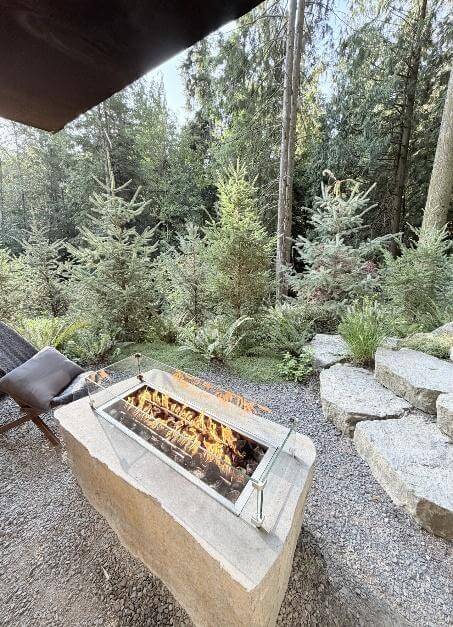
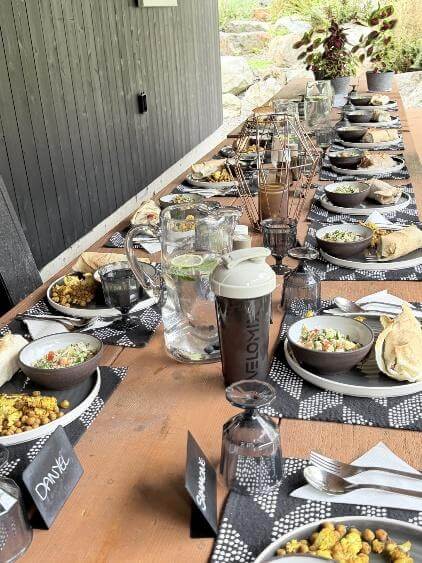
We have spent the digital age optimizing humans for machines. The AI age may require us to optimize humans for being human. The retreat weekend slowed the cognitive machine through forest bathing, glass-walled wood-fired saunas, a fire-lit outdoor lounge, peaceful outdoor showers, and long, leisurely meals prepared by an extraordinary chef. The constantly changing seating plan drew me into conversations beyond the tech bubble, including an hour-long discussion about the struggle of finding a partner through dating apps. What made the pause pivotal, however, was not any single amenity. It was the depth and breadth of the embodied experiences, and the irresistible laughter and joy of the three women leading the retreat, that finally disrupted my “go-go-go” mentality.
After three decades inside the corporate machine, I find myself asking what humans should become as machines grow more capable through AI and quantum computing. If “intelligence” is becoming abundant, what human capacities should we cultivate more deliberately? I would love to hear your thoughts.
#poorjudgementisnotanoption #judementOS #infrastructure #intuition #clarity #moralcompass #conscience #aitransformation #aiwellness #aireadyhumans
Author Bio:
Simmone Misra is a 25+ year technology veteran and a PhD student in transpersonal psychology at Sofia University. At Microsoft, she worked in the AI engineering group, working to guide CEOs on AI adoption and cultural transformation. She’s follows the principles of the religion of Jainism and hopes to focus on the impact of AI on society and the growing need for spirituality.
Sources & further reading
- Why Human Judgment Will Matter More in the Age of AI, Heidrick & Struggles (April 2026)
- The Irreplaceable Value of Human Decision-Making in the Age of AI, Harvard Business Impact (December 2024)
- Why the Future of AI Governance Depends on Human Judgment, World Economic Forum (June 2026)
- Human Judgment Is Leadership’s AI Advantage, The European Business Review (August 2026)
- Your Brain on Nature, SUCCESS Magazine (March 2026)
- Immersion in Nature Enhances Neural Indices of Executive Attention, Scientific Reports (January 2024)
- Stress weakens prefrontal networks: molecular insults to higher cognition, Nature Neuroscience (September 2015)
- Location: Nectar Yoga Retreat Centre and Mist Thermal Sanctuary, Bowen Island, BC
- Retreat curated by: SoulFlow + Co, curated yoga & wellness retreats globally, located in PNW.