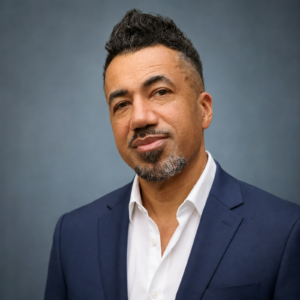

By Dr. Aaron King
Master of Arts in Transpersonal Psychology Student
Throughout much of my life, I explored my inner world with the curiosity of a therapist, the fact-finding skills of an attorney, and the critical eye of a judge. What I still needed to learn was how to observe myself without instant judgment. My quest for understanding has taken me to many places, both light and dark. It has also required me to examine my experiences, wounds, failures, and successes, and, most importantly, my relationships with others and with myself. From the outside looking in, my life has been a collection of disparate roles that, beneath the surface, connect. I have been a father, husband, soldier, educator, entrepreneur, author, artist, musician, and more. Somewhere along this journey, I became an expert in self-analysis. Perhaps to my own detriment.
Psychosynthesis Began Changing That
Developed by Italian psychiatrist Roberto Assagioli, Psychosynthesis is an approach to psychology that views human beings as more than a collection of problems to be solved. For me, this was revolutionary because it considers personality, consciousness, will, creativity, spirituality, relationships, and our capacity to grow into increasingly integrated versions of ourselves. I had always viewed these as separate things. This new framework helped me understand and articulate what I was experiencing.
I have thoughts, but I am not my thoughts. I experience emotions, but I am not my emotions. I wonder how something so simple can be so profound. Then I remember that the roles I’ve played, identities I’ve worn, wounds I’ve endured, and stories I’ve told are only parts of my experience and do not make up the entirety of who I am.
There Is Also the One Who Notices
Psychosynthesis refers to this center of awareness as the personal self, or the observing “I.” That distinction changed how I began to experience my own reactions. During an observation exercise, I imagined my observer as a wise old Buddhist monk, calm, peaceful, and unhurried. Later, during a difficult conversation with one of my adult sons, I found myself drawing on that image.
When someone I care about is struggling, my first impulse is to do something about it. The Soldier hears the problem and looks for the mission. For him, simply listening without action feels unproductive, irresponsible, and neglectful. He cares by protecting, fixing, or rescuing.
But This Time I Listened
This was a struggle for me, but by listening rather than reacting, I realized there was no mission to complete, no problem to fix, and no one to rescue. My son did not need a strategist, a savior, or a guardian; he needed his father to see and hear him. That interaction taught me an important lesson about awareness: observation does not mean passivity. Sometimes the pause between stimulus and response is precisely where the magic happens.
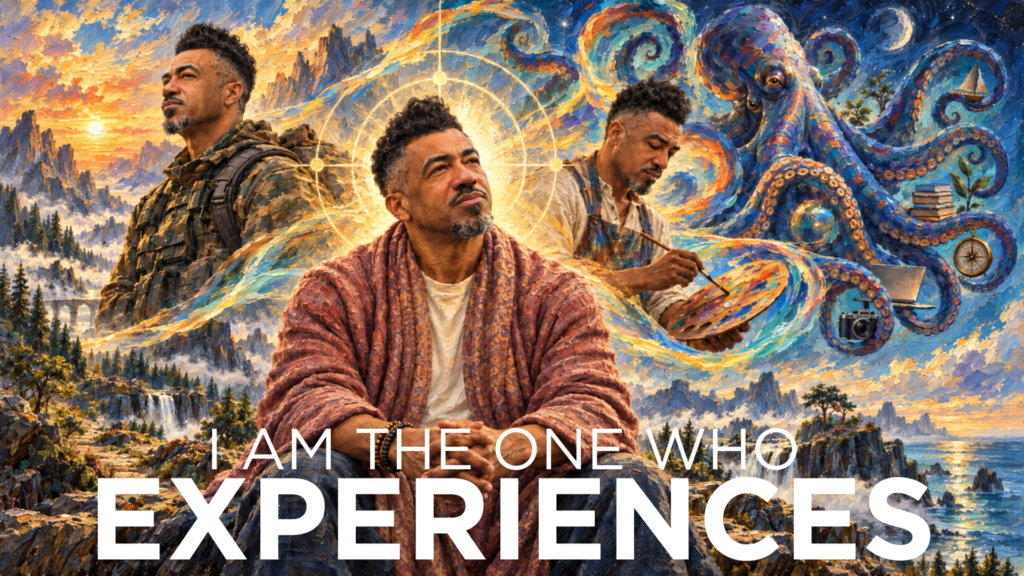
Before studying Psychosynthesis, the concept of subpersonalities was foreign to me. I learned that subpersonalities are distinct psychological patterns or “parts” that emerge within us and assume recognizable roles. Within myself, I immediately recognized three dominant subpersonalities: the Octopus, the Soldier, and the Artist.
The Octopus, with its many tentacles, symbolizes my ability to multitask, learn swiftly, and excel in various fields. Beneath this skill, there’s a childhood wish to be seen as extraordinary. The Soldier, shaped by hardship, protects, organizes, perseveres, and moves toward danger, continuing to fight even when quitting seems easier. Meanwhile, my creative side is the Artist, who has produced music, written books, made puppets, developed ideas, and envisioned new possibilities. Despite all his creations, he has often doubted his own talents. For years, I saw these parts as contradictions that led me to doubt myself, but Psychosynthesis taught me to see them as parts of a unified whole.
My Subpersonalities Are Not Enemies
When we view our subpersonalities through an observational lens, we come to understand that each developed for a reason. The Soldier helped me navigate difficult experiences early in childhood, become strong for the people I loved, survive adversity, serve as an Army combat medic, and endure situations that demanded resilience and mental toughness. But survival strategies can stay on active duty long after the war ends.
For me, the problem is not that the Soldier exists. The problem arises when he believes he must command everything. That realization also changed how I thought about will. As long as I can remember, I have associated will with toughness, discipline, persistence, and being strong-willed. Psychosynthesis offers a more nuanced perspective. Assagioli wrote about strong will, skillful will, and good will.
Strong will helps us endure. Skillful will helps us adapt. Good will asks us to consider whether what we do serves not only ourselves but also the people and world around us. That distinction challenged something I had long considered a virtue: persistence at all costs. I had spent much of my life believing that strength meant pushing through, finding another solution, or refusing to quit. The Soldier in me understood that language well. But Psychosynthesis helped me recognize that will is not the same as control. Sometimes strength means continuing. Sometimes wisdom means changing direction.
Without Awareness, Perseverance Can Become Compulsion
That realization gave me a new way to think about wholeness. Achievement has never fully eliminated insecurity, disappointment, anger, exhaustion, or old wounds. In fact, there have been times when achievement itself became a defense against feeling inadequate. That realization shifted the question.
Instead of asking, “What is wrong with me?” I began asking, “What is trying to become more whole in me?” One searches for defects. The other searches for integration. That does not eliminate personal responsibility or excuse harmful behavior. It asks us to become more aware of what operates beneath our behavior so we have greater freedom to choose differently.
This is also where I have learned to appreciate Psychosynthesis without romanticizing it. Spiritual language can be seductive. Ideas such as higher consciousness, intuition, awakening, and transcendence can sound profound while allowing us to avoid ordinary psychological work.
Not every disappointment is divine intervention. Not every closed door is the universe redirecting us. Sometimes plans fail. Sometimes people disappoint us. Sometimes life is simply inconvenient. To me, authentic spirituality must endure contact with ordinary life. It has to show up in parenting, relationships, conflict, disappointment, creativity, service, and the decisions we make when nothing mystical is happening.
As a father, I have found that lesson especially meaningful. I have learned that you cannot parent in bulk. Each child is an individual consciousness with unique needs, wounds, strengths, desires, and interpretations of the world. I may have helped bring my children into this life, but I do not own their paths.
The Same Is True Internally
Wholeness does not come from forcing every part of ourselves into submission. It comes through relationship. The Soldier may need new orders. The Artist may need more room. The Octopus may need permission to stop proving how much he can carry. And the observing “I” must learn to hear all of them without letting any one part become the whole self.
Maybe the most valuable lesson Psychosynthesis has taught me is that I am not yet complete, enlightened, or perfectly integrated. Instead, I feel more authentic. I realize that healing doesn’t mean eliminating parts of ourselves that once helped us survive. Sometimes healing involves expressing gratitude for their past support, adjusting their roles, and consciously choosing who takes the lead.
Awareness Does Not Require Condemnation
Fear, grief, anger, ambition, creativity, love, disappointment, and uncertainty can all move through me without defining me. I am not merely the experience. I am the one who experiences. And somewhere within that small yet profound distinction, my journey toward wholeness continues.
Author Bio:
Dr. Aaron King is an educator, author, entrepreneur, musician, and U.S. Army veteran whose work explores the intersection of learning, human development, consciousness, and personal transformation. He holds a doctorate in education, an Education Specialist degree, and multiple graduate degrees in instructional technology, media design, and business. He is currently pursuing a Master of Arts in Transpersonal Psychology at Sofia University. His professional background spans higher education, learning and development, educational technology, and creative industries, with a continuing focus on how people grow, adapt, and develop a deeper understanding of themselves.