
The Doctor of Machine Learning prepares you to design and lead machine learning work across science, engineering, technology, and business. Taught by Faculty practitioners from Silicon Valley and Silicon Beach, the curriculum connects theory, hands-on labs, and current industry practice at every stage.
Program Overview
The Doctor of Machine Learning is a 72-credit, 24-course professional doctorate designed for completion in 2.5 to 4 years, depending on course load. The program is delivered fully online, or in a hybrid format that combines online coursework with sessions at the Palo Alto or Costa Mesa campus.
Winter Start Date: | January 11, 2027 |
|---|---|
Spring Start Date: | April 5, 2027 |
Summer Start Date: | July 6, 2027 |
Program Length: | 2.5 to 4 Years |
Total Number of Units: | 72 |
Estimated Total Cost: | TBD |
Estimated Fees: | TBD |
Format: | Online or Hybrid |
Campus: | Costa Mesa, CA and Palo Alto, CA |
GRE/GMAT: | Not Required |
Key Program Highlights:
A few things set Sofia’s Doctor of Machine Learning apart:

Full-Spectrum Machine Learning
The curriculum runs from the math and algorithms beneath machine learning to deep learning, generative adversarial networks, natural language processing, large and small language models, computer vision, quantum machine learning, and explainable machine learning. You graduate with fluency across the whole field.
One of the Few Doctorates in Machine Learning
Most doctoral paths treat machine learning as a specialization inside a broader computer science or data science degree. Sofia built an entire professional doctorate around it, so every course, from foundations to capstone, is machine learning. Few programs in the country are dedicated to the field this way.
Cutting-Edge Curriculum at the Forefront of AI
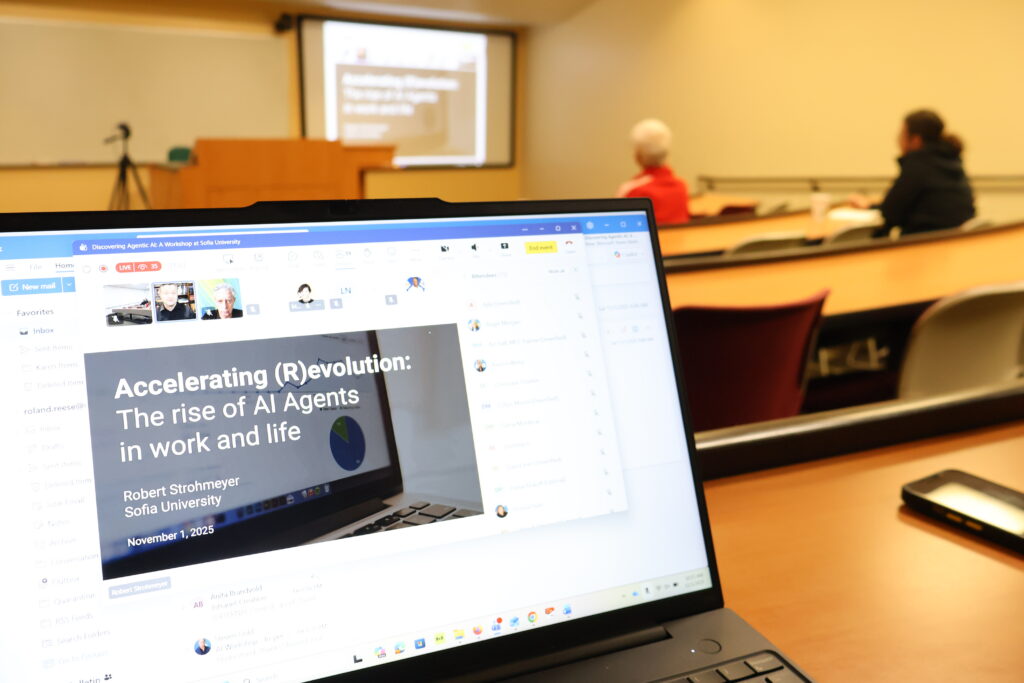
Machine learning changes quickly, so the program is reviewed and updated every quarter. Course content tracks the latest tools, research, and industry practices, with hands-on labs and programming throughout, so your training reflects how the field works right now.

A Path In, Even Without an ML Background
Already hold a master’s degree but never took AI or machine learning coursework? Start with Sofia’s Graduate Certificate in AI and Machine Learning, then move into the doctorate with the necessary foundational core.
STEM-Designated Degree
The Doctor of Machine Learning holds a Department of Homeland Security STEM designation under CIP code 11.0701.
Career Outcomes
Artificial Intelligence Engineer
Median wages
$67.45 hourly, $140,300 annual
Natural Language Processing Engineer
Median wages
$65.38 hourly, $135,980 annual
Data Engineer
Median wages
$67.07 hourly, $139,500 annual
Machine Learning Engineer
Median wages
$65.38 hourly, $135,980 annual
Computer Vision Engineer
Median wages
$65.38 hourly, $135,980 annual
AI Researcher
Median wages
$67.45 hourly, $140,300 annual
Deep Learning Engineer
Median wages
$65.38 hourly, $135,980 annual
Data Scientist
Median wages
$57.80 hourly, $120,230 annual
Computer Science Professor
Median wages vary by institution
*Salaries may differ based on locations in the U.S. or sectors served.
Source: U.S. Bureau of Labor Statistics, Occupational Employment and Wage Statistics (OEWS), May 2025 and Occupational Outlook Handbook.
Curriculum:
To receive a Doctor of Machine Learning, a total of 72 credits is required for graduation. To be admitted to the program, applicants must hold a master’s degree in a computationally technical field from an accredited institution.
Phase I: Machine Learning Foundational Core (24 credits)
The mathematical, programming, and algorithmic base of machine learning.
Phase II: Advanced Machine Learning (36 credits)
Advanced coursework across the field, from deep learning to quantum machine learning.
Phase III: Innovation and Research Capstone (12 credits)
Research, writing, and a completed applied capstone project.
Phase I: Machine Learning Foundational Core (24 credits)
Focus on the mathematics, programming, and algorithmic base of machine learning, including linear algebra, probability and calculus, Python programming, algorithms, and data structures. These eight courses must be completed before the advanced sequence.
- DML XXXX Machine Learning in Artificial Intelligence (3)
- DML XXXX Machine Learning Foundations I (3)
- DML XXXX Machine Learning Foundations II (3)
- DML XXXX Machine Learning Python Programming (3)
- DML XXXX Machine Learning Mathematics: Linear Algebra (3)
- DML XXXX Machine Learning Mathematics: Probability and Calculus (3)
- DML XXXX Machine Learning Algorithms (3)
- DML XXXX Machine Learning Data Systems and Structures (3)
Total Credits: 24
Phase II: Advanced Machine Learning (36 credits)
Focus on current research, emerging methods, and applied machine learning across specialized fields, including deep learning, neural networks, language models, computer vision, and quantum machine learning. Completed after the foundational core.
- DML XXXX Deep Learning: Foundations and Mathematics (3)
- DML XXXX Advanced Neural Networks (3)
- DML XXXX Generative Adversarial Networks (GAN) (3)
- DML XXXX Machine Learning in Robot Learning (3)
- DML XXXX Natural Language Processing (NLP) and Small Language Models (SLM) (3)
- DML XXXX Large Language Models (LLM) (3)
- DML XXXX Machine Learning in Automatic Speech Recognition (ASR) (3)
- DML XXXX Computer Vision and Machine Vision (3)
- DML XXXX Machine Learning in Quantum Computing I (3)
- DML XXXX Machine Learning in Quantum Computing II (3)
- DML XXXX Explainable Machine Learning (XML) (3)
- DML XXXX Advanced Topics in Machine Learning (3)
Total Credits: 36
Phase III: Innovation and Research Capstone (12 credits)
Focus on innovation, research, and writing in machine learning, culminating in a completed capstone project in an applied area of the field. Capstone work begins in the research courses and concludes with the two capstone courses.
- Innovation in Machine Learning Applications (3)
- Research and Writing in Machine Learning (3)
- Machine Learning Capstone I (3)
- Machine Learning Capstone II (3)
Total Credits: 12
Frequently Asked Questions (FAQs):
Sofia University’s Doctor of Machine Learning is a professional doctorate for practitioners who want to apply machine learning at a senior level rather than pursue a career in academic research. A PhD focuses on original research and a dissertation; the DML focuses on applied work and ends in a capstone you can use on the job. Both are terminal degrees.
The Doctor of Machine Learning is Sofia’s terminal degree in machine learning, for professionals who already hold a master’s. The MS in Computer Science is a master’s-level program with an AI and machine learning concentration, and the Graduate Certificate in AI and Machine Learning is a shorter credential that can also be a pathway into the doctorate.
The Doctor of Machine Learning takes 2.5 to 4 years, depending on your pace. Two courses per quarter puts completion around 3 years; 3 per quarter brings it closer to 2.5 years. Because the program suits working professionals, you set the course load that fits your schedule each quarter.
Yes, applicants need a master’s degree in a computationally technical field such as computer science, computer engineering, data science, artificial intelligence, information technology, applied mathematics, or a related area of engineering. If your master’s is in a technical field but did not include AI or machine learning coursework, Sofia offers a certificate pathway to prepare you.
If your master’s degree didn’t cover AI or machine learning, you can still enroll. Candidates whose graduate work predates Machine Learning, or whose curriculum did not include it, complete Sofia’s Graduate Certificate in AI and Machine Learning first, then enter the doctorate ready for the foundational core. The certificate covers the AI and machine learning grounding the DML requires.
The Doctor of Machine Learning covers the mathematics, algorithms, and applied skills behind the machine learning certifications employers recognize, including the Google, AWS, and Databricks credentials. Because the coursework covers the whole subject rather than one vendor’s tools, graduates are prepared to sit for certifications across platforms as their careers require.
To apply to the Doctor of Machine Learning, you’ll need to complete the online application and pay the application fee, write a statement of purpose, submit two letters of recommendation, a resume or curriculum vitae, official transcripts, proof of English proficiency and a foreign transcript evaluation if applicable, a form of identification, and pay an acceptance fee. A faculty interview may also be part of the process.