
Doctor of Business Administration (DBA) student
The Generative Dilemma
From 2023 to 2026, schools and universities shifted the way they handled generative artificial intelligence, also called GenAI. At first, a lot of institutions leaned hard on bans or tight monitoring of student use. Now the discussion feels more practical. Schools are setting clear rules about when AI can help learning and how students should use it without crossing a line.
AI is part of daily life now. It shapes work, communication, research, content creation, and the way people pick up new skills. Education has to look past the technical side, because that is only the surface. The real question is simple: how do we use AI to support learning and still keep human thinking, reflection, and judgment at the center? That question fits Sofia University’s focus on whole-person education, mindfulness, and transformation.
AI literacy is more than learning how to write a prompt. Students and educators also need to understand how AI shapes information, nudges choices, and reflects the values of the people and companies behind it. Paulo Freire described critical consciousness as the ability to question systems, understand power, and engage thoughtfully with the world. That idea matters a lot in the age of AI. Students should feel comfortable asking hard questions about AI tools, checking answers, finding reliable sources, and deciding how technology fits into their learning.
The Psychological Trap: Cognitive Offloading and Metacognitive Laziness
One of the biggest concerns with generative AI is simple enough: people may start handing over too much of their thinking to a machine. Researchers call this cognitive offloading or cognitive surrender. It happens when students lean on AI for analysis, writing, research, brainstorming, or problem-solving before they have really worked through an idea themselves. AI can help with organizing thoughts, giving feedback, and getting a project moving. It should stay there.
Learning still takes effort, and real understanding comes when students read closely, make connections, question ideas, revise their work, and learn from mistakes. Whole-person education focuses on more than a polished final product. It values the growth that happens during learning. A student who struggles through a difficult idea builds confidence, judgment, and deeper understanding. Those skills remain useful long after class ends.
AI can also give students a false sense of certainty. Generative tools often sound polite and confident. They may agree with a user’s ideas even when those ideas are incomplete or wrong. This tendency is called affirmation bias, or sycophancy. Students must learn that a confident answer isn’t necessarily correct. They should check facts and compare sources, then ask whether an AI response makes sense to them before accepting it. Strong AI literacy helps learners use these tools thoughtfully, rather than accept every answer without question.
Redefining Classroom Dynamics: The GenAI-TPACK Model
For years, educators treated technology as a classroom aid: slides, learning platforms, videos, quizzes, and online research. The teacher was still clearly directing what happened. Generative AI changes that arrangement. It can answer questions, produce drafts, suggest ideas, offer feedback, and influence how students begin an assignment. AI is no longer just sitting in the background; it becomes part of the learning process itself.
The familiar teacher-student relationship is shifting toward a teacher-AI-student relationship. Teachers still provide subject knowledge, experience, care, and ethical judgment, which technology cannot reliably replace. Students also enter this relationship with their own questions, goals, backgrounds, and responsibility for learning. AI can help both groups through practice, feedback, and idea development.
The Extended GenAI-TPACK framework gives educators a way to understand this changing connection. It makes clear that effective AI use depends on more than technical knowledge. Teachers need practical wisdom too: they must know when AI genuinely helps, when students should work independently, and how to protect the human part of education. AI literacy isn’t just about writing clever prompts. It means working with AI without pushing aside the teacher’s judgment or the student’s voice.
Re-Engineering Assessment: Process Over Product
AI changes how schools judge learning. That shift matters, since learning can disappear behind a polished submission. Many traditional assignments focus mostly on the final product, like an essay, presentation, or computer program.
They still matter, of course, but they show less about how a student actually built the idea. Authentic assessment pays closer attention to the learning process. It asks students to show research, explain choices, share early drafts, reflect on feedback, and talk through how they reached a conclusion. That lets educators see understanding more clearly.
A student might hand in a first draft, point to the sources that shaped their thinking, describe how feedback changed the work, and name what was cut or kept in the final version. That makes the thinking visible. It also puts more responsibility on students, which is fair.
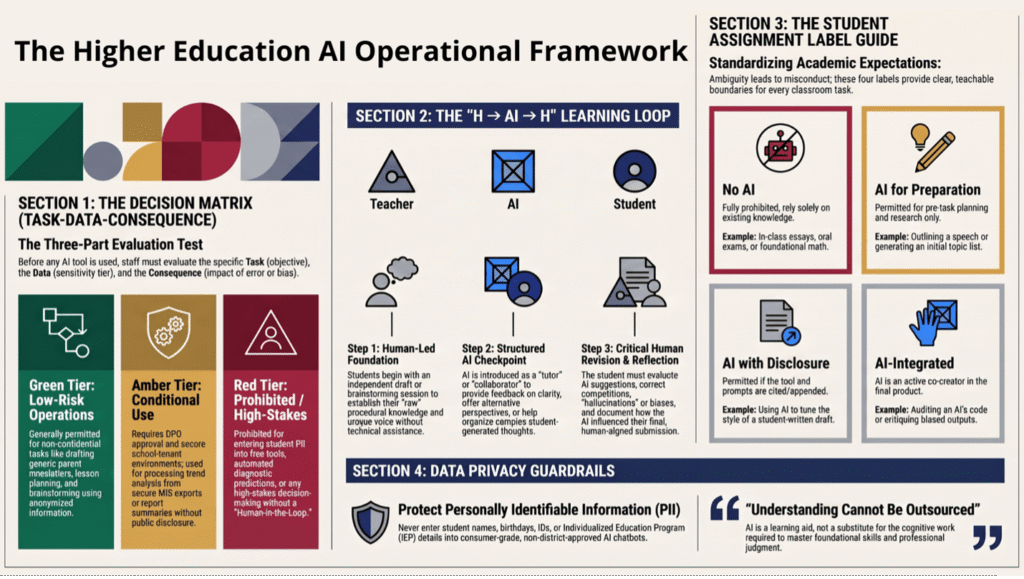
The AI Assessment Scale, or AIAS, provides a clear structure for different levels of AI use in class.
Level 1: Independent Work. Students complete work using their own knowledge and skills. Examples include handwritten reflections, live discussions, oral presentations, or in-class writing activities.
Level 2: AI for Understanding and Clarification. Students may use AI to explain a concept, define terms, summarize background reading, or answer factual questions while they study. All planning, drafting, and analysis stays with the student, and any AI explanation gets checked against course materials or a reliable source.
Level 3: AI for Planning and Brainstorming. Students may use AI to explore a topic, organize ideas, or create an outline. The student then develops the actual assignment in their own voice and includes original drafts when appropriate.
Level 4: AI for Editing and Evaluation. Students use AI as a study partner or editor. AI may suggest changes, point out unclear writing, or offer feedback. The student reviews those suggestions and decides which ones improve the work.
This framework makes expectations clearer and pushes teachers to create assignments that build learning, rather than reward dependence on a generated final answer. Some educators may use a Process Validation Metric (VM) to see how thoughtfully students examine AI suggestions.
Students can record which suggestions they accepted and which they changed, then explain how they checked the facts against reliable sources. That matters because AI use should involve judgment, not a rushed copy-and-paste.
Data Mindfulness, Safety, and Compliance
Mindful AI use also means taking privacy and responsible data handling seriously. Schools and universities keep sensitive student information, from academic records to contact details and disability accommodations.
Before bringing an AI tool into a classroom, educators need to know how it collects, stores, and uses information. Some public platforms save prompt histories or use submitted data to improve their systems. Educators cannot treat student information casually.
Institutions, not just individual teachers, share that responsibility, especially when students are minors. Laws such as the Family Educational Rights and Privacy Act, known as FERPA, help protect education records.
The Children’s Online Privacy Protection Act, or COPPA, also protects children’s information online. Schools need to make sure the AI tools they use actually fit those duties. Educational leaders should also watch for changing laws around AI-generated content. Oregon House Bill 2299 expanded Oregon’s intimate-image law to include realistic AI-generated or altered intimate images shared without consent. Federal legislation, including the TAKE IT DOWN Act, also pushes accountability for non-consensual synthetic media. All of this shows why AI education has to include safety, ethics, and responsible use.Before adopting an AI tool, schools can use a simple three-part evaluation process.
Task Evaluation: Does the tool support learning, reflection, and student growth?
Data Evaluation: What information will students or teachers enter into the tool, and how will that information be protected?
Consequence Evaluation: What could happen if the AI gives an unfair, biased, or incorrect result?
These questions help schools make better decisions. They also ensure that people remain responsible for important choices involving grades, student placement, safety, and wellbeing.
Conclusion: Always Center Human Agency
AI can help education become more personal, flexible, and engaging. It can support students who learn best through video, audio, visuals, discussion, practice, or direct feedback. It can also help educators create learning experiences that better fit the needs of each student.
I think of AI like an electric bicycle. It can help a rider travel faster and farther, but the rider still chooses the direction, watches the road, and decides where to go.
The same idea applies to education. AI can support human effort, but people should remain in charge of the goals, decisions, and values that guide learning. Students need opportunities to think deeply, ask questions, create original work, and build confidence in their own abilities.
Through mindfulness, critical thinking, and responsible governance, schools can use AI to support meaningful learning. The goal is not simply to teach students how to use an AI tool. The goal is to help them become thoughtful, independent, ethical people who can use technology wisely.
For educators, leaders, and professionals interested in exploring this topic further, I created a course on AI Education, Ethics and Data Compliance. It focuses on practical ways to use AI in learning environments while protecting student data, supporting critical thinking, and keeping human agency at the center.
References
Perkins, M., Roe, J., Furze, L., & MacVaugh, J. (2024). The AI Assessment Scale (AIAS).
Teaching Support and Innovation, University of Oregon. (2024). Authentic Assessment Strategies and Rubrics.
Smowltech Editorial Team. (2026). Student Roles and Practical Wisdom in Authentic Digital Evaluations.
Thomas, A. P. (2024). Balancing Innovation and Integrity: Addressing Concerns of AI in Classroom Environments. Graduate Research, Grand Valley State University.
EDSAFE AI Alliance & Friday Institute. (2026). Capstone Report: Responsible Artificial Intelligence Education Implementation Pack.
Utrecht University Board of Governors. (2026). Guidelines on the Classification of High-Risk AI Systems.
EAB Strategic Research. (2024). How to Craft an AI Acceptable Use Policy to Protect Student Privacy.
Oregon Department of Education. (2026). Generative Artificial Intelligence (AI) in K-12 Classrooms Guidance.
Massachusetts Department of Elementary and Secondary Education. (2026). Five Core Ethical Principles of State AI Guidance.
Kharbach, M. (2026). Thinking Fast, Slow, and Artificial: How AI Is Reshaping Human Reasoning and the Rise of Cognitive Surrender.
Demir, S., Uşak, M., & Kodirov, O. S. (2026). Three inseparable facets and five new knowledge domains: An extended GenAI-TPACK proposal. Pedagogical Research, 11(3).
Fan, Y., Tang, L., & Gasevic, D. (2025). Beware of metacognitive laziness: Effects of generative artificial intelligence on learning motivation. British Journal of Educational Technology, 56(2).
CASRAI Standards Board. (2026). University AI Academic Integrity Policy Trends.