
How an Aikido course at Sofia University inspired an educational song
by Krisztian Priol
M.A. Counseling Psychology Candidate, Sofia University
“You always give bad advice.”
My classmate Ludo was trying to hit me while saying those words. He was playing the role of a frustrated client, and I was supposed to respond as the therapist.
Surprisingly, this wasn’t a counseling class. It was Aikido: Mind & Body Integration with SueAnn Sensei at Sofia University.
My first task was not to defend myself. It was to stay composed and centered. Then I stepped beyond the strike without taking it personally and gently connected with Ludo using my hands. Instead of reacting to the insult, I replied, “I’m curious if you’re feeling frustrated,” and allowed his momentum to continue while gently guiding its direction.
What fascinated me was how closely every step of a physical encounter mirrored a verbal conflict.
Walking away from that exercise, I kept thinking: Why isn’t verbal aikido already a sport?
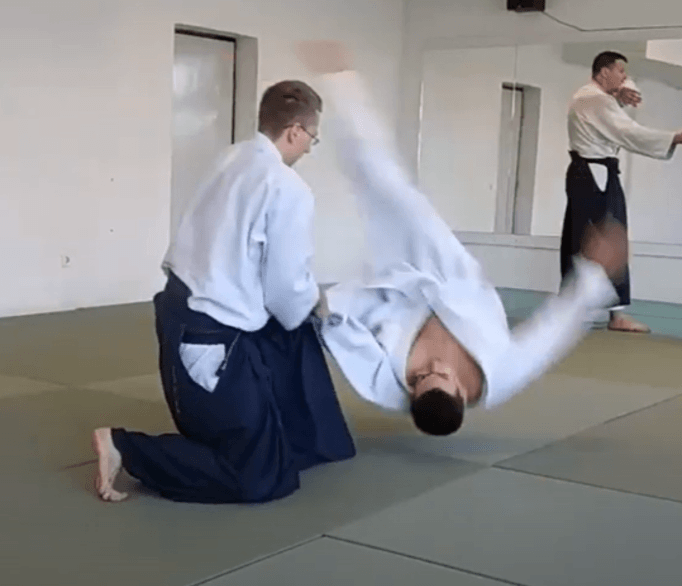
When I enrolled in the course, I expected to revisit a martial art I had practiced years earlier. I had trained in aikido for about three years, as shown in the left photo, yet I had never connected it with counseling or everyday conflict resolution until taking SueAnn Sensei’s course at Sofia.
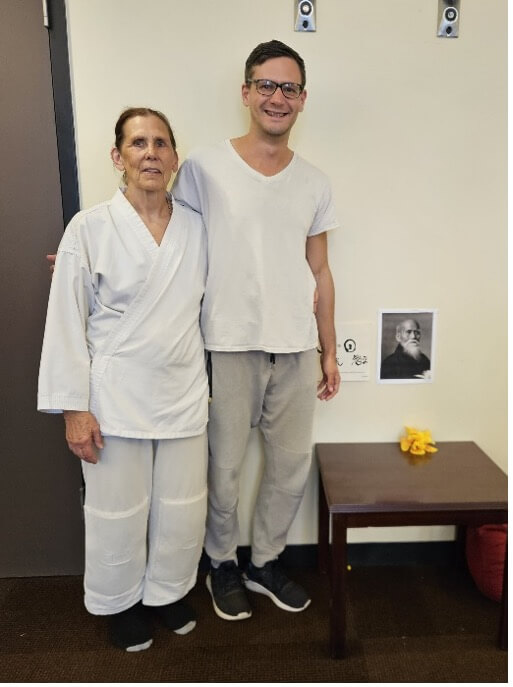
Instead, I discovered something much deeper. Aikido was not simply teaching techniques. It was teaching a way of relating to ourselves and to other people.
Throughout the course, SueAnn often reminded us to “stand like a mountain” and keep “soft eyes.” Those ideas stayed with me because I experienced them through my body, not just my mind.
I was especially excited to discover that “soft eyes” also appears in neuroscience. I had previously heard Andrew Huberman describe engaging peripheral vision as one way to help regulate the nervous system. Seeing the same principle appear in Aikido gave me an even greater appreciation for the practice.
As a Counseling Psychology student, I appreciate how Sofia values experiential learning. We do not only learn through lectures and textbooks. We also learn through movement, improvisation, reflection, and creative expression. These experiences stay with me because they involve the whole person.
The experience above eventually inspired one of my psychoeducational songs, Aiken: Hear the Forgotten Song.
Several lyrics came directly from SueAnn’s teachings:
- “Stand like a mountain.” Remain centered.
- “Soft eyes.” Stay composed and aware.
- “Step beyond the strike.” Don’t take insults personally.
- “Connect.” Stay present with the client.
- “Guide.” Gently redirect rather than oppose.
For me, these are no longer just phrases from class. They have become a song I can return to whenever I experience conflict or criticism.
The song tells the story of General Aiken, a medieval warrior who believes every shadow is an enemy until he realizes that every attack is trying to protect something precious.

Instead of fighting every attack, he learns to soften his eyes, remain connected, and respond with understanding rather than opposition. That mirrors one of the most meaningful lessons I learned in Aikido.
When someone attacks us, our first instinct is often to defend ourselves or fight back. In Aikido, however, we step out of the line of the attack while staying connected with our partner. Rather than becoming consumed by the attack itself, we become curious about what it is protecting.
That shift, from opposition to curiosity and empathy, has influenced how I think about conflict in counseling and everyday conversations.
In my strengths-based framework, Quantum Dream, negative emotional reactions become symbolic protectors rather than enemies. For instance, the Wolfdog represents our survival instincts and protective emotions. The Storm symbolizes the dark thoughts that often accompany conflict. Aiken’s sword, the Resonance Blade, is shaped like a tuning fork because its purpose is not to conquer an opponent, but to restore harmony. That symbolism grew naturally from learning that the “Ai” in Aikido means harmony, reminding me that Aikido is often translated as “the way of harmony with life energy.”
The course also showed me that practicing empathy does not have to be only verbal. It can be expressed through symbolic movement and embodiment, almost like an action movie.
We often assume learning happens through lectures and reading books. And those are also important. However, some lessons become ingrained in us because they are experienced through the body, emotion, and art.
A melodic message can keep replaying in our minds.
A lyric can return during a difficult conversation.
A simple phrase like “listen beneath the attack” or “hear what it protects” can suddenly become exactly what we need in a stressful moment. That is when learning continues beyond the classroom.
Today, Aiken: Hear the Forgotten Song is part of my larger strengths-based psychology project, Quantum Dream. Each song combines storytelling, psychology, and a short reflective practice to help people apply psychological ideas in everyday life.
You can listen to the full song and read the reflection that goes with it here:
https://quantumdream.life/aiken/
Looking back at my first year in the Counseling Psychology program, I realize Sofia was the right choice for me because it aligns so well with my whole-person and transpersonal values. Finding a therapist training program that embraces those values is rare, which is one reason I feel grateful and at home at Sofia.
If even a few of us remember to stand like a mountain, keep soft eyes, or listen beneath the attack during a difficult conversation, then the learning continues long after the class has ended.
Perhaps the next time someone is told, “You always give bad advice,” they’ll hear something deeper beneath the attack.

Krisztian Priol
M.A. Counseling Psychology Candidate, Sofia University
M.S. Positive Psychology | B.A. Psychology

Creator of Quantum Dream™
Helping people feel deeply seen through strengths-based psychology.